Wednesday, December 9, 2020

Throw Away Your Review Mirror

Better Decisions, Fewer Regrets: 5 Questions to Help You Determine Your Next Move - Andy Stanley – (Zondervan)

I knew right from the start that I was going appreciate the thoughts and advice that Andy Stanley puts forth in his new book, Better Decisions, Fewer Regrets: 5 Questions to Help You Determine Your Next Move. Stanley starts with a story about seeking advice from his father in which his Dad responded to a question, with a question.

While often that can be an annoying habit, it is one that I can totally relate to. I can’t tell you the number of times that my wife, my children or a business colleague has come to me asking for guidance and my response has come in the form of a question. More often than not, I know exactly what the right answer is, but I almost never serve up that answer. The reason is simple, I can tell you what I would do in the circumstance, but the answer would be the right one for me, which is not necessarily the case for the person seeking answers.


If you took the advice, and it didn’t work out, then it would be my fault. Not that I am afraid to take responsibility for my actions, I just don’t want to take responsibility for your actions, or often your inaction. Instead, Stanley’s Dad, walked him through a process, with a series of questions that helped to guide him to the right answer, for him.

In Better Decisions, Fewer Regrets, Andy Stanley boils things down to a series of five basic questions to use to help guide you through life and to live a life with fewer regrets.

1. "Am I being honest with myself, really?"

2. "What story do I want to tell?"

3. "Is there a tension that needs my attention?"

4. "What is the wise thing to do?"

5. "What does love require of me?"

I think we all have at least some regrets in our lives; things we would have done different, decisions we wish we had made differently, choices we would not make if we could get a do over. I often use the analogy of living life looking in the rearview mirror, seeing things that are behind us.

What Stanley lays out for us in Better Decisions, Fewer Regrets, is a process that will help not eliminate those regrets, but certainly help us reduce them. Think of it as an opportunity to toss out our rearview mirror mentality.

Friday, November 20, 2020

Going the Extra Two Inches

 Good Company – Arthur M Blank (William Morrow)

If you own a business, or aspire to start a business, you need to read this book. If you are in a leadership role at a company or aspire to a leadership role, you need to read this book. Even if you just aspire to just lead a better life, I suggest you read this book.

Why? You may be asking. The answer is simple, in Good Company, Arthur M. Blank, one of the co-founders of Home Depot and the current owner of the Atlanta Falcons football team, does the best job I can remember, of detailing how to live a life and run a business base on core values. Further than that he gives a perfect look at what living a life of abundance is all about.


Now you may be scratching you head and saying, “it’s easy to live a life of abundance when you’re a billionaire.” That misses the point; abundance is not about what you have or how much of it, it’s about your attitude and the choice you make to have an vision of the world that is based on whether you view the world through a lens of scarcity or have the vision of an abundant life.

While almost every company has what they call mission, vision and values; you know the faded poster hanging on the wall in HR or the one in the cracked picture frame in the lobby, in Good Company, Blank goes a step further by stressing that it’s more important than just having values, you actually have to live them.

The concepts he outlines are straight forward. They include:

1.   Put people first

2.   Listen and respond

3.   Include everyone

4.   Lead by example

5.   Innovate continuously

6.   Give back to others

I could delve deeper and spell out more, but this series of values are not difficult to understand, it’s the execution part that trips most people up. Blank offers multiple great examples of each of these steps in real practice and the outcomes they lead to. In a world where success and successful people are vilified, Blank truly raises the bar and sets the tone for how you can be wildly successful and still be a respected, caring citizen of your community. He drives home the customer-centric vision that each and every one of his business endeavors is based on. It’s not about going the extra mile once in a while, but going that extra two inches every single time. I can state without equivocation that I would love the opportunity to work with Mr. Blank, or any true servant leader who approaches business the way he does.

Thursday, November 5, 2020

Think Different: About Creativity

 The Creative Mindset: Mastering the Six Skill That Empower Innovation – Jeff DeGraff and Staney DeGraff (Berrett-Kohler Publishers)

Creative. The word alone can get people nervous and shaky. Creativity, that’s for artists, writers or musicians…right? At some point, if not all the time, any business can need a shot of creativity, a new idea, a new way of thinking, a new way to solve a problem.

So, can you teach people to be creative? Probably not, but you can help to build a formula for understanding how being creative works. Jeff and Staney DeGraff have built that roadmap in the form of The Creative Mindset: Mastering the Six Skill That Empower Innovation.

The DeGraff’s boil down their six steps to the acronym CREATE: Clarify, Replicate, Elaborate, Associate, Translate, and Evaluate. You will have an   A-ha! moment as you realize how much sense these steps make. Here are the steps spelled out with my input:

Clarify – Understanding, and most importantly, you have to communicate clearly the challenge at hand.

Replicate - Mimic and build on your new ideas. This can set the creative tone for your team/business.

Elaborate – You may have the kernel of a great idea, but don’t be afraid to take that idea and add new alternative tweaks or ways of thinking to help build on the idea.

Associate - Connect ideas with analogies to help others clearly understand a concept and in what direction we are headed.

Translate - Stories are priceless tools and help drive ideas home within your team and to your customers. Create stories based on your ideas.

Evaluate – Consistency is import here; select the best ideas to fit team expectations and it will help aid buy in and keep everyone is on the same page.

There isn’t a lot of over-technical science involved in this. We are talking actionable steps that you can put into practice with your team and in your business pretty quickly. I recently facilitated a leadership, team building session where I rolled out some of these steps to the group and you could almost see the lightbulbs turning on above their heads as the grasped concepts and then carried them forward into the next exercise. It was really that easy to connect to purpose.

Thursday, February 13, 2020

Coach in a Box

Career Rehab: Rebuild Your Personal Brand and Rethink the Way You Work - Kanika Tolver (Entrepreneur Press)

It used to be you’d choose a career path; go out and get the tools you need, (education, training, etc) and set about applying for jobs with either an application or a resume. Once you landed a job, you would settle in and spend the next 40 years working your way to that fateful day when you would either reach retirement or drop dead from the career stress if you weren’t.

To say that things have changed is a complete understatement. Today careers take a completely different look; while job hopping was once viewed dimly, now people in charge of hiring start to wonder about you if you hang around one place for too long. Marketing has become a skillset that every job seeker needs to have in their toolkit and the product you market, is you. If you tell someone from a prior generation that you have hired a job/career coach, you’d likely have to explain exactly what that is and what they do.


No matter where you are in your career arc and are considering utilizing the skills of career coach, I’d like to recommend that a good first step is grabbing a copy of Kanika Tolver’s new book Career Rehab: Rebuild Your Personal Brand and Rethink the Way You Work. Served up in useful, digestible chunks, Career Rehab offers easy action steps that you can implement today.

Tolver truly helps you to reexamine the entire process of having, growing and may I say enjoying your career. She helps you to treat your career like it’s a product not your whole existence. In one of the best sections of the book, Tolver actually discusses...wait for it...MONEY. Yep, getting paid, one of those things the old school says you should not talk about. Tolver tackles this by helping you to understand your value and actually get paid what you are worth.

Career Rehab isn’t one of those books you have to read cover to cover; it’s set you so you can pick and choose those sections that help you tackle the issue(s) you are facing today and need to tackle tomorrow. You don’t need to hire a coach, you literally got a coach in a box, in the palm of your hand.

Thursday, August 15, 2019

Well Brewed Advice


The Coffee Bean: A Simple Lesson to Create Positive Change - Jon Gordon and Damon West - (Wiley)

Bestselling leadership and personal development author Jon Gordon teamed with talented newcomer Damon west to serve up a handy, little, book version of West’s presentation The Coffee Bean, which details the challenges and stresses faced by a young student named Abe.

A teacher gives Ab a life-defining insight which asks the simple, if albeit confusing question; are you a carrot, and egg or a coffee bean? Without giving away too much of the story; think about those times when you feel like life is on full boil and how you react to those situations. Now think about what happens to a carrot, and egg and a coffee bean when they are brought to a boil. The analogy, while a first is not obvious, soon becomes striking in its simplicity.

At 112 pages, with illustrations, The Coffee Bean, is a quick read – think of it as a kicked up Powerpoint in a handy to access format. Some may squabble over the brevity or the perceived lack of depth in delving into the subject or it being too simplistic in its approach. While I would never quibble with your right to complain, I think in this case you’re missing the point.


The Coffee Bean, parable is really based on guiding the reader/student – in the book, the character Abe – to see that there are three paths that you can choose in life. The goal in my estimation is not to smooth all of the bumps in those paths, but to help you better understand what goes into the choices we all make and the outcomes or consequences of the choices we make.

In the end, isn’t that a message that is suitable to anyone at any age or personal/career development level? The fact that Abe is a student signals that basic fact. I am not sure how seriously I would take a book that somehow promises a one size fits all solution.

The Coffee Bean, for me, is one of those go to books I like to keep within reach and share with family, friends, mentees, clients, and colleagues who may be struggling with difficult questions or challenges, that can offer clarity, a sense of direction or purpose.

Thursday, May 9, 2019

A Lifeline for the Overwhelmed

Free to Focus - A Total Productivity System to Achieve More by Doing Less - Michael Hyatt (Baker Books)

If you are anything like me, then you on a seemingly never ending quest (no, quest is not too strong a word) for the right system to organize your schedule, collect your important notes and research, and your big ideas.

I have a leaning tower of of notebooks, journals, planners and binders in a variety of shapes and sizes teetering on the corner of my desk; each chock full of brilliance. Be it great research, winning ideas, and tons of executable plans all in search of a direction. On the floor next to the desk is the oversized, multi-pocketed, back pack that I need to haul it all around.

What's missing is a coherent way to organize and focus all of the myriad stuff into a real plan and EXECUTE on this stuff. One of the biggest issues is often actually finding what is where. The leadership stuff in in one black journal, book research is in an identical book, then there is the marketing stuff in the leather bound notebook and the communications plans in the Moleskinne. Oh, and I am drafting this review in the green canvas bound journal. In short, a mess.


While the term productivity can conjure the image of guys in cheap suits, with pocket protectors and a stash of red pencils all looking to chop staff; in reality-productivity is about making the best use of your time. This kind of productivity i snot about just doing stuff, but doing stuff that matters. While many folks have taken a stab at developing a productivity system, it is my belief that leadership guru Michael Hyatt and his team have clearly put time, energy and experience into the development of the Full Focus Planner. This not something that looks or feels like a first take on a planning system.

Now Hyatt has taken things to the next level with the release of Free to Focus - A Total Productivity System to Achieve More by Doing Less, which not only fleshes out how to maximize the impact of the planner, but also everything that goes on around it in both your business and personal life. This is not to say that the book wouldn't have an impact as a stand alone - without the planner.

I was struck by the amount of emphasis Hyatt rightly placed on cutting, eliminating and setting boundaries around your time and how to better hone in on only the most important stuff. Hyatt does not sugar coat the fact that for this to work to it's full potential it will take some heavy lifting. If you accept and buy into the change process at the heart of this, the results will speak for themselves.

I think that while there is some flexibility - this is clearly not a pick an choose proposition where you can take the bits you like and leave the rest. Like I said, this is a system based on experience; if it's in here it is based on proven practice. If nothing else, the system will help bring a focus to some of the roadblocks - real, imagined or self-created that are standing in the way of your success.

Wednesday, March 27, 2019

Inevitablity is Built In

Turning the Flywheel: A Monograph to Accompany Good to Great - Jim Collins - (Harper Business)

Jim Collins' seminal bestseller, Good to Great is not what I would normally consider a traditional business/leadership book; I think it set out to expound on the elements that went into separating good companies, from great companies and along the way it drew not so much a map but a set of guideposts that companies/leaders can put to work on their journey to greatness. It is one of the few books in the category that I find myself re-reading/listening to and one that I regularly buy copies of for friends, colleagues and clients.

So picking up on this monograph was a natural step.Turning the Flywheel: A Monograph to Accompany Good to Great, takes the concept of a business flywheel, first espoiused in the book, and clarified by time and practice and is expanded by the efficacy of countless proven examples of success. What once was a chapter, is now expanded to to the proper depth and breadth in the form this monograph.


Collins details some of the companies that have put the flywheel concept into successful practice. I think the clarity with which he writes about the built in inevitability that is part of a successful flywheel. It is not just a list of steps companies can take put in some random order or a circular pattern. That inevitability comes when nail a step leads naturally to the next and the next to build the momentum of success.

That success is built in the developmental stage and Collins explains the steps you can undertake to "capture your flywheel." Collins, along with the examples that lace this monograph suggests that four to six elements is a workable number and more will make things too complicated to build the momentum you need. He also makes solid suggestions on how to avoid what he dubs the "doom loop."

While I think it's perfectly clear that there is no one size fits all, plug and play flywheel that you can adapt to your business and it's unique drivers (markets/competition), I think there are certainly transferable pieces in the examples that dot the book that may make sense to put into play in your flywheel. My marked up copy has copious notes and sticky notes littering the 40 pages.

Friday, February 1, 2019

Stuff…Doesn’t Make You Happy

The Minimalist Home – A Room By Room Guide to a Decluttered, Refocused Life – Joshua Becker – (Waterbrook)

I have often said that there is a thin line between collector and hoarder. Over time I have come to believe that line between collector and compulsive gatherer is even more narrow and that we have created a way of life to feed that compulsion. The older I get the more I have come to believe that stuff and more stuff, can’t make you happy and that most of the things that we cling to because “we might need it someday” is almost certainly misguided.

With basements, garages and backyard sheds overflowing into countless and multiplying storage sheds and lockers; a new innovation/movement has sprung to life – minimalism. While minimalist acolytes come in a variety of forms and approaches; one of the leading progenitors of the movement via blogs and books is Joshua Becker. Becker sets his sights on your home space in his latest book, The Minimalist Home – A Room By Room Guide to a Decluttered, Refocused Life. Some may complain that there is nothing new here that Becker hasn’t covered in prior books/blogs or he doesn’t offer specific enough strategies.


I liked the fact that Becker offers an overview of minimalism, without feeling the need to drill down and tell what to do or what to chuck. Some will take minimalism to an extreme – stuffing a minimum of necessities into a duffle and lead a vagabond life in a succession of AirBNBs, worldly possessions in tow. Becker’s approach strikes me  to take a more thoughtful or thought provoking path, so you can develop your own processes and checklists.


Becker has even been slagged for assuming his readers live in houses and not apartments and injecting Christian principles into his writing. Sorry, but you have to be a nitpicky pinhead if you can’t gain value from the insight Becker offers into simplifying, downsizing and focusing on real joy in the freedom offered by minimalism. 

Wednesday, January 23, 2019

The Road To Joy

Chief Joy Officer – How Great Leaders Elevate Human Energy and Eliminate Fear – Richard Sheridan – (Portfolio)

“Joy – a feeling of great pleasure and happiness.”

So, how’s your work place/work life? If you’re a leader, what’s your perspective? What would your staff/employees say? Does the definition of joy apply? If the concept of joy and work in the say thought seems like a foreign concept, then it might be time to re-evaluate where you are at.

One starting point on the road to re-evaluation would be the guidance offered by Richard Sheridan in the form of Chief Joy Officer: How Great Leaders Elevate Human Energy and Eliminate Fear. Sheridan takes what you think might be a daunting task and boils it down to a simple, focused step by step process.


One of the best places to start is with developing a level of self-awareness as a leader. What is your purpose? If you can’t clearly articulate the answer then how can you expect your team to. The root of joy stems from leaders defining purpose, aligning people to “get real work done” by inspiring, motivating, and developing your team.

I loved Sheridan’s sentiment that joy cannot be found when people lead with fear. If you have been working for any length of time, you have likely encountered this type of “leader.” They seemed to be inordinately fixated on things that don’t move the needle other than what they deem as a hot button issue.

One of the best (worst?) examples I can think of was an over-weight, sloppy, CFO who was fixated on the company dress code of all things! The failure of leadership was compounded by a weak CEO who could have cut off the discussion to return focus to what really mattered, instead of allowing the senior leadership team to be dragged through countless hours of discussion and policy drafts only to end up with an over-long, confusing mess that the front-line staff found onerous and off-putting; it was a soul-sucking, nightmare that engendered no joy as they feared making the wrong choices.

GM CEO Mary Barra simplified things with a two word policy; “dress appropriately.” This is an example of a leader engendering trust, a building block of joy, and keeping focus on much larger and more important things. If your dress code is an issue, it may really be a people issue rather than the way you lead them.


Sheridan correctly makes the case that leaders make more leaders. It no surprise that leadership guru Tom Peters, who made that a cornerstone principle of his teaching, authored the foreward to Chief Joy Officer.

Wednesday, November 7, 2018

Go Your Own Way

The Bullet Journal Method – Ryder Carroll – (Portfolio)
Leaders of all stripes and leadership coaches in an array of business sectors, have almost universally endorsed the practice of journaling as a way to grow leadership skills ranging from strategic planning, communications skills, self-awareness, core values, and goal development and measurement.

Like planners, there are a multitude of journals and journaling systems that include old school pen to paper and electronic programs and apps. I have been amazed at the number of folks that I respect who have extolled the virtues and capabilities of a range of cloud based/accessible applications. Then a few short weeks or months later they return to the old, reliable pen and paper route; or as I have become fond of, pencil and paper – there’s nothing quite like the scratch of a Dixon Ticonderoga or Mirado Black Warrior. Lately I found that for some inexplicable reason – ideas flow to life with these old school tools.


Much like the multi-faceted apps, there are any number of journaling systems on the market. One of the most ballyhooed of the bunch is the Bullet Journal or BUJO. The system’s inventor Ryder Carroll posted the detail of his system on the web and things took off in a viral fashion.

Now Carroll has put together what I have dubbed the BUJO Bible in the form of the book, The Bullet Journal Method. Carroll fills in the details of the story behind the development of the concept as a way to not only address his struggles with attention deficit disorder (ADD), but also what he felt were shortcomings with other systems.

Bullet Journal always struck me as a bit on the obsessive compulsive disorder side, with its pretty intensive focus on so many moving parts. It seemed to me that I would spend so much time building out the pieces of the journal and moving journal entries around that I would miss out on doing actual work of projects.


Carroll goes a long way towards clearing up that misconception by demonstrating that BUJO gives you the freedom to take the parts of the system that work for you, to create your own system. You can get as complex or as stripped down as you need, which the brilliance of the system. If what you need is not in here, why not go out a create your own. 

Coach In a Box

Business Boutique – 2019 Goal Planner – Christy Wright (Ramsey Press)

The Search for a “system” be it organizer, goal tracker or journal, seems to be an ongoing, ever evolving process for folks in business, often based on where you are in your career path. To say that there is no one size fits all is an understatement. I have tried any number of professionally packaged and even some personally developed systems, both on paper and electronic with varying degrees of success. I can say that I tend towards the old school, writing and paper side of the equation.

Coach/blogger/podcaster and bestselling author Christy Wright, founder of the Business Boutique brand, is out with a strikingly complete planning system, dubbed, Business Boutique – 2019 Goal Planner. In my experience, the one common denominator of systems, paper or electronic, is that there is generally something missing or incomplete when it comes to meeting my needs; which is why I eventually settled on using a combination of pieces for my system.


Wright has put together a nice, sturdy planner, housed in a nice box. The set includes a great combination of elements that will guide you through business goal development and execution over the course of the one year package.
While Wright’s focus is on helping female entrepreneurs and the design clearly leans in that direction - the elements of this system amount to what is a business coach in a box; with monthly lessons/assignments that cover a range of topics. Wright offers up macro monthly planning calendars as well as weekly working calendars. Importantly the planner also includes monthly review pages so you can take stock of progress and achievements, access your goals and reset your planning to keep your projects on track.


Whether it’s for a startup or experienced business person/entrepreneur – Wright’s system demonstrates/shares a lot of hard earned experience that will help you to success.

Friday, September 14, 2018

The Narrative Driven Business

Five Stars: The Communications Secrets to Get from Good to Great – Carmine Gallo (St. Martin’s Press)

“What do you do for a living?”

It’s a simple question that gets asked every day in any number of social and networking situations as an icebreaker. Over the course of time and a multitude of career transitions I have landed on what I believe to be a great response: “I am a professional communicator.”

That simple answer covers the full gamut of my careers in print and broadcast media, marketing and public relations and coaching. Don’t get me wrong; while the answer is simple the communications skills that have served me well throughout my career(s) were hard won. Those skills are the focus of the new book from bestselling author and communications guru Carmine Gallo, Five Stars: The Communications Secrets to Get from Good to Great.
Strong communications skills used to be treated as a desirable tool to have in your kit; a nice resume bullet point, but not a mainstay skill for most businesses. Gallo makes the strong case that top flight, five star, communications abilities are what separate the big dogs from the rat terriers.


Great Ideas

Simply having great ideas is not enough – it is the ability to convey and clearly communicate those ideas and to persuade others that will increase your value in the business world and in life. Like his bestselling books, Talk Like Ted and The Storyteller Secret, Gallo doesn’t just set the premise, he serves up the action steps that you can put into play to develop, grow and improve you communications skills to the point where you can elevate them to five star status.

No matter what technological advancement or future disruption that may come down the pike, these necessary communications skills are what will give you a leg up on the competition. The reality is, this is not some new innovative twist – some of what Gallo imparts here has been around for centuries. Where he succeeds is by putting it into easily digestible bits that you can put into practice right out of the box.


It is a somewhat sad, but great example of how far we have moved away from the classical education/teaching of things like Aristotle’s, Art of Persuasion. This really boils down to developing the ability to string together words in a manner that moves the needle, that gets people to take action. Oddly enough when it’s done correctly, most people don’t even realize they have been persuaded, but when it’s done badly, it’s clunky and obvious in its failure. With Five Stars, Gallo offers up the path to finding that extra step that will separate you from those with merely good communications skills.

Friday, August 31, 2018

A Wake Up Call For Business

Reinvent Your Business Model: How to Seize the White Space for Transformative Growth – Mark W. Johnson – (Harvard Business Review)

Try as I might, I could not think of any industry or business sector that has not been impacted by digital transformation. Now more than ever businesses need to be nimble and be able to act both proactively and re-actively to competitive challenges and disruption.

The flat out failure of so many businesses who either could not or would not change their business model should be a wake up call that is loud and clear. Tick of the list: Sears, Kmart, Bonton, Toys R Us, Blockbuster, Blackberry and many others. That clarion call, while not new, should have you asking if you are prepared to take action and if you have the structure in place to transform your business for growth.


Strategy and innovation consultant Mark W. Johnson has been championing for businesses to be ready to take this kind of action since his 2009 book Seizing the White Space. Johnson has revised and updated the book and the title in Reinvent Your Business Model: How to Seize the White Space for Transformative Growth to account for the blisteringly rapid pace of change that has occurred in the interim.

In the book, Johnson lays out a great, workable framework for business to embrace dynamic change and put it into practice right out of the box. If your scratching your head and wondering where to even start a transition, Johnson provides a road map to reinvention. I have never been a fan of reinventing the wheel, but reinvention may be a misnomer here; this is more of guide path to retooling the way you do business that gives you a leg up on the process by identifying the tools you need for success.


You will likely have more than a few AHA! Moments, as Johnson identifies not only what companies have done successfully, but also illustrates with examples those that failed to act in in turn failed outright. The advice offered up here is useful to both existing businesses to make the transformation or startups to put the framework in place from the start to be nimble from the get go.  

Tuesday, August 28, 2018

You Can't Shrink Your Way to Success

Growth IQ - Tiffani Bova - (Portfolio)

I remember it clearly...the first time I told a CEO "you can't shrink your way to success. The. Line seemed to hit him like a sledgehammer, jarring him from another cloudy discussion about layoffs, cost cutting, and delaying facility repairs. This was not the first discussion of this type; and while similar cost cutting had resulted in short lived bumps, this was not going to work much longer.

The fact that the concept of growth seemed somehow shocking spoke volumes about this particular executives mindset. I laid out a growth strategy and once the ball got rolling my line about shrinking to success moved from me being credited to the CEO assuming credit for it in a very short term when it started to work. I love it when a plan comes together. Growth can comes in many forms, in fact business growth strategist Tiffani Bova clearly defines ten growth strategies in her excellent new book, Growth IQ.


Ten Growth Paths


This really isn't brain surgery and Bova boils it down to ten pretty clear paths to growth:

1. Customer Experience - Inspire additional purchases and customer advocacy 
2. Customer Base Penetration - Sell more existing products to existing           customers

3. Market Acceleration - Expand into new markets with existing products
4. Product Expansion - Sell new products to existing customers
5. Customer and Product Diversification - Sell new products to new customers 
6. Optimize Sales- Streamline the sales process to increase productivity
7. Churn - Retain more customers
8. Partnerships - Leverage third-party alliances and channels
9. Co-optition - Cooperate with market or industry competitor 
10. Unconventional Strategies - Disruption of current thinking/process


Bova does a nice job of illustrating and detailing each of these growth paths with real world examples that are specific, without becoming esoteric or overly white-papery. The examples add substance to the action steps that you can put into play to get the ball rolling quickly. While each of these growth paths can be stand alone, she also makes the case that you can run on more than one of these paths at a time with the proper synchronization, so they don't bump not each other during execution. Timing is everything.

While I am not sure that Bova put the growth paths in any particular order, I am a big fan customer experience being great path to growth. Customer experience can be a huge differentiator and engendering loyalty can result in dynamic growth; with a great reduction in customer acquisition cost. The basic rule of business is it's cheaper to sell something to an existing customer than it is to acquire a new customer.

Bova also spells out the factors you should weigh when determining which growth path(s) you should choose. This is critical information because making the wrong choice can cause more damage to your business than a lack of growth. Growth IQ offers a phenomenal knowledge base from which to work on your growth evolution. 

Friday, August 17, 2018

Missed Opportunity

How Schools Work: An Inside Account of Failure and Success from One of the Nation's Longest-Serving Secretaries of Education - Arne Duncan - (Simon and Schuster)

I've got to be honest, I don't quite know what to make of, How Schools Work: An Inside Account of Failure and Success from One of the Nation's Longest-Serving Secretaries of Education, by Obama Secretary of Education, Arne Duncan. Named the ninth Secretary of Education in 2009, Duncan oversaw the turmoil that public education has become in the United States trough 2015.

With How Schools Work, Duncan ha the opportunity to shine a first hand knowledge spotlight on those school's that are working well and what they do to successfully navigate the roadblocks and issues that stop so many schools from delivering on their primary charge; educating kids.


Those issues are legion; ranging from disinterested or impaired parents, infrastructure failures, teacher's and their unions, forced social engineering, school violence, funding issues, and on and on. Rather than citing those schools who manage to overcome these hurdles, Duncan instead serves up an odd mishmash; part memoir of his journey in education, part recap of the challenges facing educators,  part liberal boilerplate screed and all topped off with his thoughts on gun violence. Oh, and as the cherry on top there is the seemingly obligatory eight point plan too fix the problems.

While the story of his journey to and through the education ranks is interesting and he clearly displays a demonstrable passion for educating, I was left short by the missed opportunity that I felt this book presented. The opportunity comes in the form of addressing an increase in accountability and an effort to refocus on actually providing a useful education that prepares students for a better future, whatever direction that might lead them. Instead of focusing on social engineering and how Johnny feels about himself, why not give Johnny the tools he needs to be successful or even break the cycle that has often hampered generations. Instead of viewing parents as adversaries, why not engage them to participate in the process of educating their kids. Instead of whining about a layoff funds why not offer a ground up overhaul of how schools can work better by how they are managed. Like I said, missed opportunity.      

Thursday, August 16, 2018

What You Should Stop Doing

Detonate: Why - And How - Corporations Must Blow Up Best Practices (and bring a beginners mind) to Survive - Geoff Tuff and Steven Goldbach - (Wiley)

"If it's not broke don't fix it," became a popular business axiom, that later became "If it's not broke, break it." If you find that your business, in whole or in part, is stuck in a rut because your business operating principle has become "because that's the way we've always done it," then it's probably time to give some thought to bringing a little disruption to your game.

A pair of Deloitte business consultants, Geoff Tuff and Steven Goldbach are out with a new book  Detonate: Why - And How - Corporations Must Blow Up Best Practices, that advocates bringing disruption, almost for the sake of disruption. I think there is a need for careful delineation to be put into play, before you take a sledgehammer to your business practices.  


First you have to account for the specifics of your business and industry. In some business sectors, best practices are actually rewarded. Take healthcare for example; where so-called core measures, a set of industry recognized best practices for treatment protocols. These standards of care get monitored and measured and can result in higher reimbursements, notably from government payers. It would not only be silly to detonate these best practices, but counter productive to the bottom line.

Certainly there are a myriad of opportunities to disrupt healthcare delivery, that could positively improve the bottom line and should be explored to improve not only patient outcomes, but also patient experience.

One of my all time favorite business questions is "what should we stop doing?" We spend so much time looking for opportunities that involve expanding what we do, that we miss the opportunities that lie in stopping doing things that aren't working or aren't contributing to our business in a meaningful way. This is where the lessons distilled in Detonate can have the greatest impact on your business.  

Tuesday, August 14, 2018

Let Go of the Coconut

Mastering Fear - A Navy SEAL's Guide - Brandon Webb and John David Mann (Portfolio)

I work with folks all the time who have great ideas, the ideal entrpreneurial skill set, and the desire to branch out and run their own shop. Many put the pieces in place, business plans, market research, working with consultants to bullet proof (as much as you can) the process and some even get the financing lined up. Just when you think they are ready to pull the trigger, they back away and leav everything on the table.

So what stops them? More often than not, the only thing stopping you, is you. And what stops you? Fear. Maybe it's the great uncertainty, the great unknown; the lingering doubt of "what if" this doesn't work out? For is the great equalizer that levels the playing field and often level great ideas.


In Mastering Fear: A Navy SEAL's Guide, retired Navy SEAL and bestselling author Branddon Webb, along with John David Mann (The Go-Giver series) offer up on of the best fear analogies ever with the story of the monkey and the coconut. Webb describes how a friend in the Philipines explained how they trap monkeys. "They dig a hole, place a coconut in it; the monkey reaches in and grabs the coconut, and his fist is now too big to pull out. He's trapped. All he has to do is let go of the coconut. But he won't do it. Why not? What keeps the monkey;s fist clenched? Fear. H's afraid of losing what he has, so he keeps the coconut and loses his freedom.

You want to take the leap and do your own thing, but for keeps your fist clenched on your coconut.

Webb draws on his vast experience in battle and business to craft, along with Mann, a playbook of five steps you can take to overcome your fears in business and in life. No you don't have to have survived the arduous Navy SEAL's BUD/S training course to apply these strategies to make marked improvements in your life.

I loved the chapter on knowing what matters. This seems like it should. Be pretty basic, common sense stuff, but I have found it's what often trips people up. Sometimes it real. Is as simple as knowing when to let go of the coconut.

Wednesday, August 8, 2018

Powered By Ideas

Breakthrough: How To Harness the Aha! Moments That Spark Success - Scott Duffy - (Enrepreneur Press)

"Don't be afraid of new ideas. Be afraid of old ideas. They keep you where you are an stop you from growing and moving forward. Concentrate on where you want to go, not on what you fear," - Anthony Robbins

As I considered Scott Duffy's new book, Breakthrough: How to Harness the Aha! Moments That Spark Success, for some reason on got locked in on a quote about ideas with out action, that I had heard or read at one time, but remained just out of my mental grasp. A quick Google search and I came across the Anthony Robbins quote above and thought that it was a good fit, when you consider that Duffy was once in the employ of the Robbins organization.


The quote is also fitting in that Duffy is offering a substantial primer on not only how to seize on great ideas, but how to shift into execution/action mode. As you progress through the process, he also demonstrates the action steps to grow and scale you business.

Duffy hits all the marks, delivering easily digestible chunks on leadership, making smart, informed choices for the next steps in you business development cycle, including; transitions, culture and building sustainability. He takes this beyond the theoretical by illustrating many of the. Steps with interviews and example from successful entrepreneurs including Robbins, Gary Vaynerchuk, and Daymond John among others.

While I tend to chafe at the shelf full of books that seemingly endorse failure as a business option everybody should take a swing at, I fully endorse not fearing failure from limiting your business decisions and learning from failure; I appreciated Duffy's clear illustrations about some of the potential issues that come with scaling and how you can avoid them with poor planning.

Monday, July 9, 2018

Stop Running Around the Room


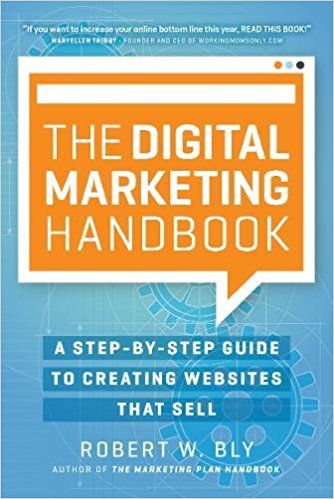
The Digital Marketing Handbook: A Step-by-Step Guide to Creating Websites That Sell– Robert Bly (Entrepreneur)

So, how is your website doing? The so-called experts will all tell you that your business must have a web presence, but they don’t often tell you why. So, you go out and build out a website and depending on how much your budget is it may look slick, have some nifty doo-dads and maybe it even tells some of your business story, but how is it doing? Is your website driving sales, or customer experience; is it at least filling your sales funnel?

If you are scratching your head and not sure what the answers are, then you probably really have your answer. You may be guilty of what I call running around the room! Some guru tells you, you need a website or a Facebook page or a Twitter account, so you go out and do just that. The question then becomes, WHY? If you find yourself being pulled in twenty different directions, all the while chasing the new, shiny, thing; then you will want to take a break and invest some time with Robert Bly’s new book, The Digital Marketing Handbook: A Step-by-Step Guide to Creating Websites That Sell.


Bly has made a career out of cranking highly effective marketing copy that does exactly what it’s supposed to do; sell products and services. PERIOD. If you are a small business or looking to fire up a side hustle or even make the transition from side hustle to full blown business, this is a great starting place to gather knowledge of how to build out a website the actually makes you money! And isn’t that the bottom line?

If you are an experienced marketer, Bly approach may seem a little basic, but I can’t tell you how many people I work with that that invest in building out a website, only to have it not produce the results they thought it would and then who take the attitude that “this internet thing doesn’t work” or use the now famous line “I was too late, everybody already had a website like mine”.
Let’s face it, even folks who do this for a living are playing a game of catch up because the digital realm is changing seemingly every day. If you don’t have a solid foundation to build on then things like AdWords, landing pages, click through rates and the multitude of social media sites will all amount to deciphering hieroglyphics. Bly delivers the basics in easy to understand chunks and action steps that you can put into play right out of the box to start impacting your business today. Once you mastered the delivery, I would even suggest picking up one of Bly’s books on how to write effective copy that sells.

Thursday, July 5, 2018

Avoid the Void


The Power of a Positive Team – Jon Gordon – (Wiley)

Have you ever been a part of a successful team?

How about a team that did not quite meet expectations or failed miserably?

Looking back at those experiences were you able to break things down and get to the bottom of what worked well, or where things went off the rails and failed miserably? It’s always a good idea to do that kind of postmortem break down to identify what works best.

In his latest book, The Power of a Positive Team bestselling, business and team guru Jon Gordon not only walks you through what the elements of a successful team are, and as the title suggests, how a positive team proves to be more successful. Now that may not sound like brain surgery, but as always, Gordon really offers some definitive insights, often based on scientific research about the mindsets that go into the chemistry of teams.


One of my go to stories when coaching teams or individuals, is about going to your favorite book store and asking for a book on how to be better at being negative, as I used in my review of Jon’s book, The Power of Positive Leadership. I spend a lot of time focusing on the impact of communication, good and bad, on businesses, and I love the chapter here that focuses on how communication impacts teams. Jon hits it out of the park when discussing how teams need to avoid the void; when there is a void in the process, more often than not, negativity will fill that void. He illustrates how effective communication within the team and its individual members can eliminate the void and cut down on negativity.

If you look at problem areas in most businesses, no matter what the business type or industry, communications are almost always at or near the top of the list. Gordon really drives home the point that while communication is “often the last thing you want to do” it is “the most important thing you must do.” He suggests a number of effective vehicles for communication among teams; it boils down to finding the method that works best for the team and the situation because it is not a once size fits all proposition.

Teams and team work comes in a multitude of varieties and Gordon offers great ideas and actionable steps the can help you keep those teams working in a positive fashion and with great results. This is a straight forward book, that you will want to keep handy so you can plug these steps into action.